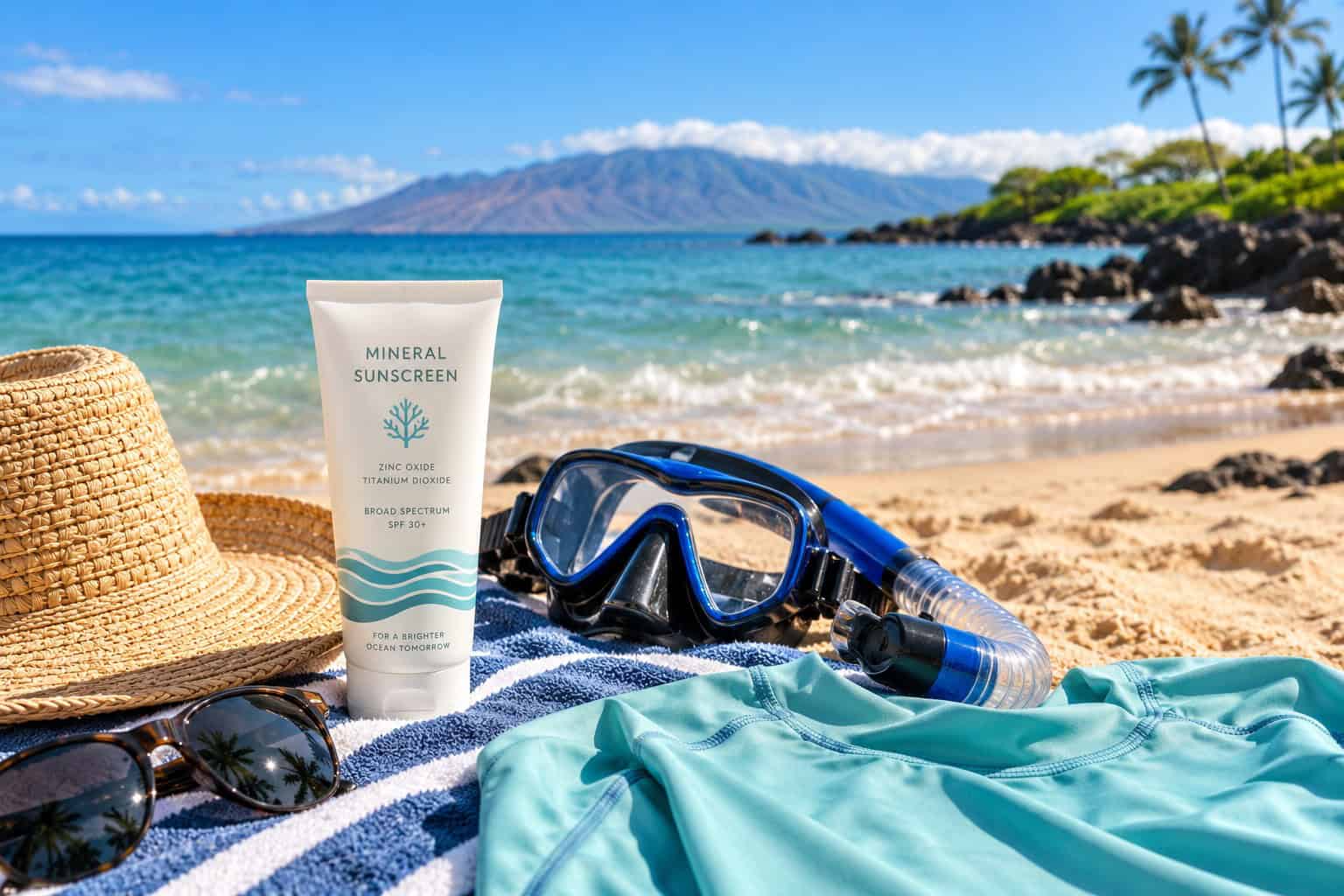
What if the sunscreen already packed in your suitcase is not the kind you should be using in Maui?
It is an easy detail to miss. You pack the sunscreen you already use at home and assume you are ready for beach days, snorkeling, and time on the water.
But Maui County has specific rules for what sunscreen can be used, and words like “reef safe” or “reef friendly” on the bottle do not necessarily tell you whether a product meets them.
Fortunately, checking is simple.
Before your trip, look at the active ingredients. In Maui, choose mineral sunscreen made with zinc oxide, titanium dioxide, or both.
It only takes a few seconds. Check before you pack, and you can arrive prepared with sunscreen that meets local requirements, protects your skin, and makes a more thoughtful choice for the ocean you came to enjoy.
Maui’s Sunscreen Law: What Travelers Need to Know
You may hear about both Hawaii’s statewide sunscreen law and Maui County’s mineral sunscreen ordinance. They are related, but they are not the same.
Hawaii’s statewide law, which took effect January 1, 2021, prohibits the sale and distribution of sunscreens containing oxybenzone or octinoxate without a prescription.
Maui County goes further.
Under Ordinance No. 5306, which took effect October 1, 2022, non-mineral sunscreens cannot generally be sold, distributed, or used in Maui County without a prescription.
For travelers, the practical takeaway is simple:
Choose sunscreen with zinc oxide, titanium dioxide, or both as the active ingredients.
Maui County also recommends choosing non-nanotized zinc oxide or titanium dioxide.
Knowing that before your trip means one less thing to sort out after you arrive.
Why Sunscreen Ingredients Matter in the Ocean
Picture a typical Maui morning.
You apply sunscreen, grab your snorkel gear, and head into clear water with a reef just offshore. As you swim, some of what you put on your skin can wash into the surrounding water.
NOAA reports that certain chemical UV filters found in sunscreens and other personal-care products can harm corals and other marine organisms.
Research involving oxybenzone has documented effects including coral bleaching, DNA damage, and abnormal development in young coral.
Scientists continue to study how different UV filters affect reef ecosystems.
It is also important to keep sunscreen in perspective.
Coral reefs face much larger and more complex pressures, including climate change, land-based pollution, coastal development, disease, unsustainable fishing, and invasive species.
Choosing mineral sunscreen will not solve those problems.
But it is one impact visitors can reduce themselves—and it starts with something as simple as checking a label.
Do Not Let the Words “Reef Safe” Choose Your Sunscreen for You
This is where shopping can get confusing.
A bottle may feature coral imagery or phrases such as “reef safe,” “reef friendly,” or “ocean friendly.” But Maui County warns that terms like these are not regulated and can be misleading.
So do not let the front of the package make the decision for you.
Turn the bottle around and read the active ingredient panel instead.
That tells you far more about whether a sunscreen fits Maui County guidance than environmental claims printed on the label.
How to Choose Mineral Sunscreen for Your Maui Trip
Once you know to choose mineral sunscreen, look for the qualities that also support effective sun protection.
For Maui County guidance:
- Consider non-nanotized zinc oxide or titanium dioxide, which Maui County specifically recommends.
For your own sun protection:
- Choose broad-spectrum sunscreen for protection against both UVA and UVB rays.
- Use SPF 30 or higher, as recommended by the American Academy of Dermatology.
- Look for water resistance if you plan to swim, snorkel, paddle, hike, or spend time sweating outdoors.
- Follow the product’s reapplication directions, especially after swimming, sweating, or towel drying.
The distinction matters. SPF, broad-spectrum protection, and water resistance are sun-protection recommendations, not requirements of Maui County’s ordinance.
Buying sunscreen after you arrive? Use the same approach: read the active ingredients and sun-protection information rather than relying on environmental claims alone.
Make Sunscreen One Part of Your Sun Protection
Sunscreen does not have to do all the work.
Protective clothing and smart timing can make a Maui beach day easier on your skin while also reducing how much sunscreen reaches the water.
Maui County recommends seeking shade, wearing protective clothing, and avoiding peak sun hours between 10:00 AM and 2:00 PM when practical.
Suggested options include hats, long-sleeved clothing, rash guards, and wetsuits.
For a morning snorkel, you might wear a long-sleeved UPF rash guard and apply mineral sunscreen to your face, neck, legs, feet, and other uncovered areas.
Back on shore, add a hat, sunglasses, and some shade.
Cover what you comfortably can. Protect the skin that remains exposed. Reapply sunscreen as directed.
It is a straightforward routine that gives your skin more than one layer of protection.
A Better Maui Beach Routine Does Not Have to Feel Complicated
Responsible travel should not make your vacation feel like a list of rules.
A little preparation before you leave your vacation rental can actually make the day easier. Pack the right sunscreen, bring protective clothing, and plan for shade or a break when the sun is strongest.
Then the preparation is done.
Swim. Snorkel. Settle into the sand. Take your time along the coast.
Knowing what to bring before your trip means fewer decisions once you are there—and more time to enjoy the experience itself.
Stay Close to the Maui Experiences You Came to Enjoy
Where you stay can also shape the rhythm of your beach days.
When your vacation rental is near the coast, every ocean outing does not have to become an all-day event.
You can head out early, return for lunch or a break from the sun, and go back to the water later if you feel like it.
AA Oceanfront offers Maui vacation rentals in Maalaea, North Kihei, South Kihei, and Wailea.
That puts guests within easy reach of beaches and other coastal experiences.
The real benefit is flexibility.
Head out when it feels right. Take a break when you need one. Return to the coast later instead of feeling like you have to stay outside through the strongest part of the day.
Explore Maui vacation rentals with AA Oceanfront and choose a home base that makes it easier to enjoy the coast on your own schedule.
Protect Your Skin. Help Protect What You Came to See.
No single sunscreen choice will determine the future of Maui’s coral reefs.
But taking a minute to check what you pack is an easy place to start.
Choose mineral sunscreen that meets Maui County requirements. Pair it with shade, protective clothing, and sensible sun habits.
Then head to the beach prepared to protect your skin while reducing one avoidable source of stress on the marine environment.
You came to Maui to experience the water, beaches, reefs, and open coastline.
Pack with them in mind, and make caring for the place part of the experience.